
Your Office Looks Great. Is It Working? Four Gaps Holding Workplaces Back
A workplace can look great. But what defines a good day at work is whether the space helps people get their work done.
Most U.S. leaders (96%) say they are making changes to their offices, or plan to in the next few years, to better support their teams. That’s encouraging. But new Steelcase research across nine countries reveals that many of those efforts aren’t landing where they matter most.
Here’s the most telling finding: globally, the number one reason people say they come to the office isn’t to do their best work. It’s because they’re required to. Focus, collaboration, access to tools and a sense of belonging all rank behind “work requirement.”
The research, published in the Spring 2026 issue of Steelcase’s Work Better magazine, identifies four specific gaps holding the office back. The encouraging news is that targeted improvements in these areas, even subtle ones at first, make a measurable difference right away.
The expectation gap
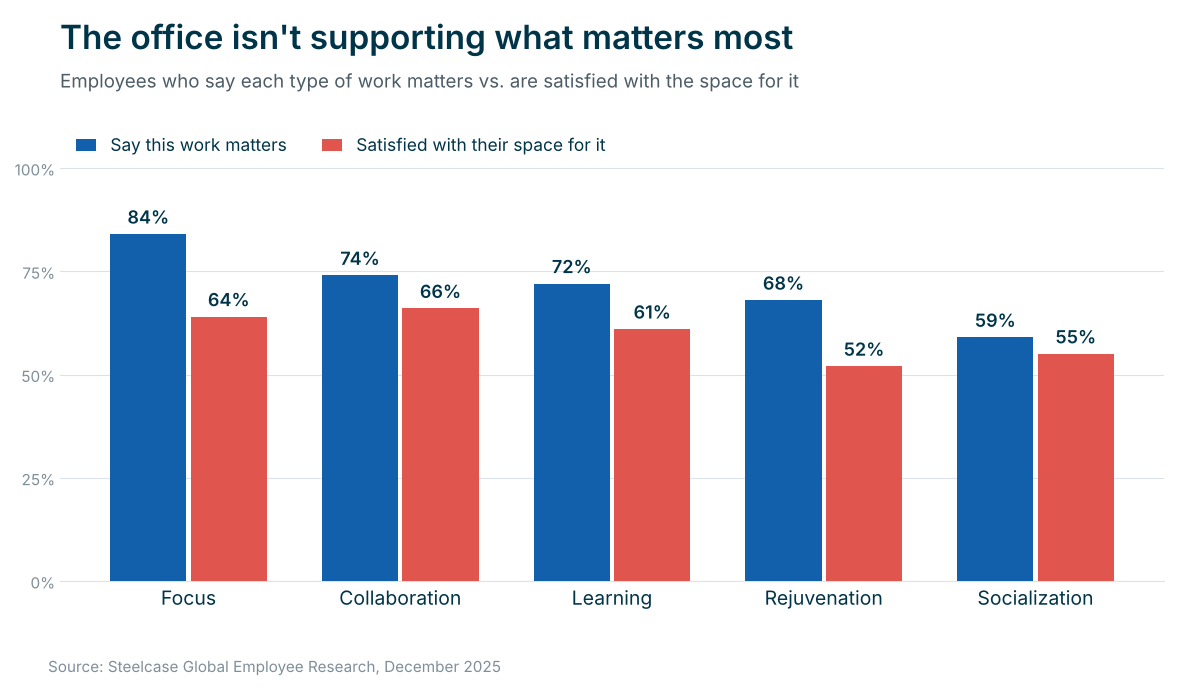
Across every kind of work, there is a consistent pattern: people rate the work as important, and then rate their space for doing it noticeably lower.
- Focus work: 84% say it matters. 64% are satisfied with their space for it.
- Collaboration: 74% say it matters. 66% are satisfied.
- Learning: 72% say it matters. 61% are satisfied.
- Rejuvenation: 68% say it matters. 52% are satisfied.
- Socialization: 59% say it matters. 55% are satisfied.
The gaps are sizable and they have a real impact on how people feel about coming in. Closing them is where the four gaps below come in.
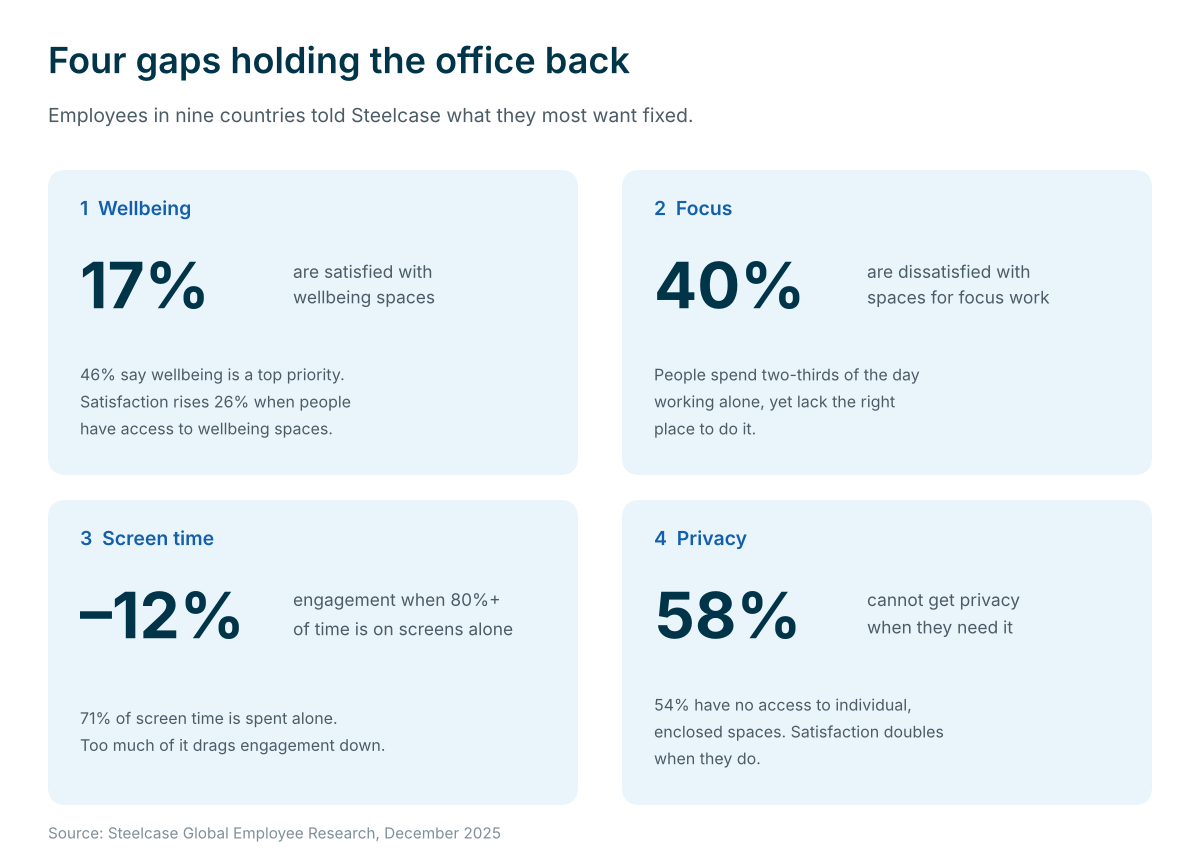
Gap 1: Wellbeing is the number one request
When employees are asked what they most want improved in the office, wellbeing is the top answer. 46% call it a top workplace priority. Yet only 17% are satisfied with the wellbeing spaces they have.
The upside is significant. When people have access to wellbeing spaces, office satisfaction rises 26%. This doesn’t have to mean a full wellness suite. A quiet room for a reset, a comfortable lounge away from the open floor, or a space with natural light and softer materials can shift how a whole floor feels.
Gap 2: Focus work has nowhere to go
On average, people spend two-thirds of their day working alone. Despite that, 40% are dissatisfied with the spaces available for focus work.
This is one of the most common things we hear walking client spaces across the Carolinas and Georgia. Open plans were built for collaboration, but the day-to-day reality is that most work is heads-down. Enclosed focus rooms, pods and booths, and well-placed acoustic solutions give that work a home without rebuilding the floor plan.
Gap 3: Screens are draining engagement
Screens now dominate the workday. People report that 71% of their screen time is spent alone, and the research shows a clear cost: engagement drops 12% when people spend 80% or more of their time on screens by themselves.
The answer isn’t fewer screens. It’s giving people good reasons and good places to step away from them: spaces that invite in-person collaboration, rejuvenation and casual connection throughout the day.
Gap 4: Privacy is in short supply
58% of employees say they cannot get privacy when they need it, and 54% have no access to individual, enclosed spaces. For the majority of people who don’t have a private office, finding privacy is tough.
Privacy is also the lever that touches the other three gaps. It supports wellbeing, enables focus and gives people somewhere to take a call that isn’t their desk. The payoff is striking: workplace satisfaction doubles when people have access to individual enclosed spaces.
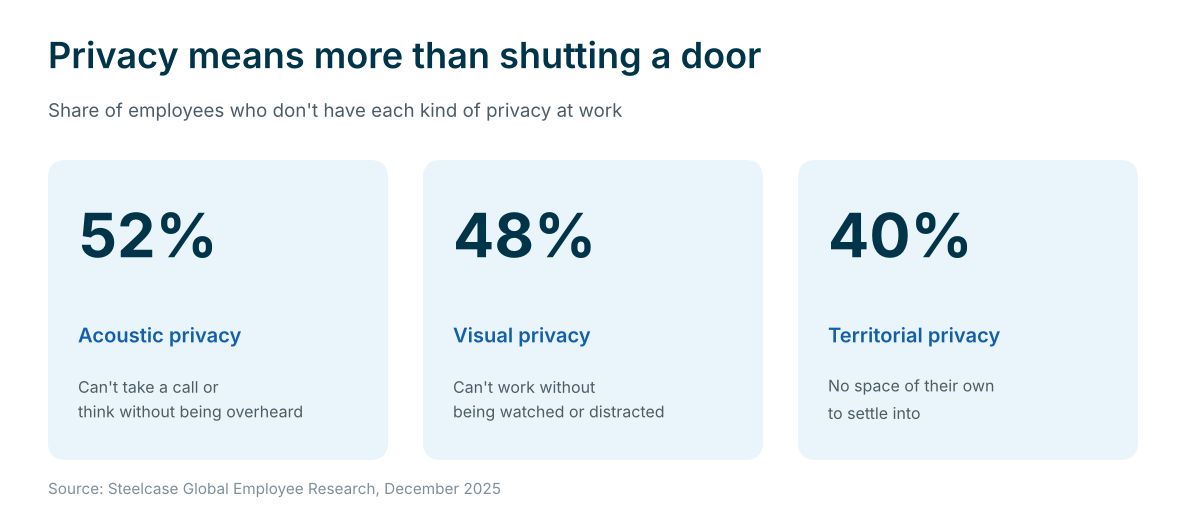
It helps to think about privacy in three types, because employees need more than the ability to shut a door:
- Acoustic privacy (52% don’t have it): the ability to take a call or think without being overheard.
- Visual privacy (48% don’t have it): working without feeling watched or distracted.
- Territorial privacy (40% don’t have it): a space of one’s own to settle into.
What actually works: variety, not square footage
The research points to one lever with outsized impact. People with access to three or more types of spaces that support different kinds of work report:
- 14% higher engagement
- 16% stronger sense of community
- 13% improved wellbeing
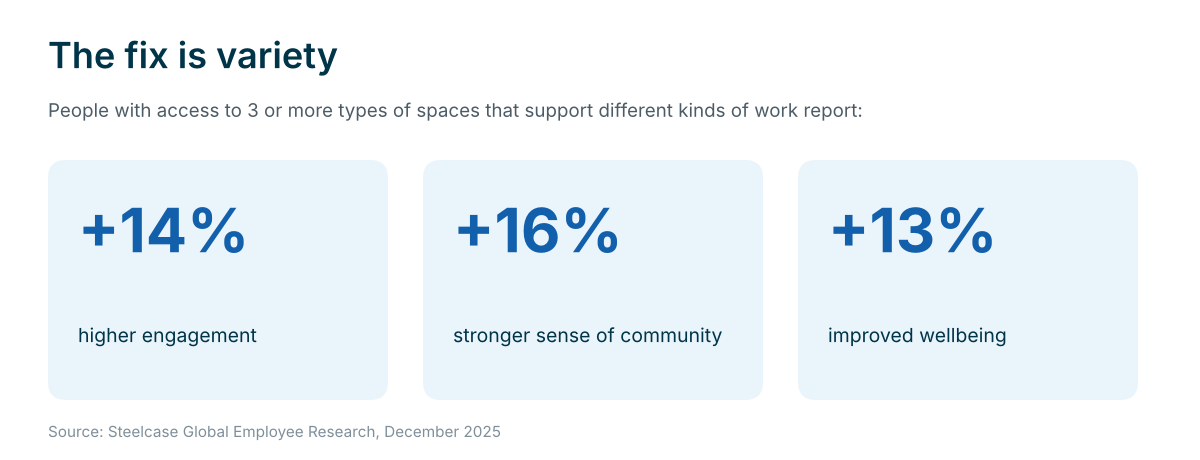
The message is clear. When workplaces support how people actually work in different ways throughout the day, people perform better and feel better. That’s what turns the office from an obligation into a place people want to be.
Closing the gaps in your space
Most of these gaps don’t require a full redesign. In our experience, a few targeted moves make the difference:
- Add enclosed space. A handful of focus rooms, phone booths or meeting pods addresses focus and privacy at once. Modular walls make this possible without construction.
- Create a wellbeing setting. Convert an underused corner or conference room into a space built for rest and reset.
- Solve acoustics. Sound masking, acoustic panels and soft flooring reduce noise and improve speech privacy across the whole floor.
- Rebalance the mix. Audit how much of your floor is open workstations versus enclosed, social and rejuvenation space, and adjust toward variety.
- Integrate technology thoughtfully. Put video calls in rooms designed for them so desks aren’t the default for every screen-based conversation.
As a Steelcase partner with eight locations across South Carolina, North Carolina and Georgia, Young Office helps organizations identify where these gaps show up in their space and close them with furniture, modular walls, flooring and technology working together as one plan.
Want to see how the four gaps apply to your office? Book a 30-minute space review with a Young Office workplace consultant. CONTACT US
Read the full research in the Spring 2026 issue of Work Better magazine. CLICK HERE
Source: Steelcase Global Employee Research, December 2025, published in Work Better magazine, Spring 2026.